
Begin a Warren County Record Search
A Warren County property search is really a chain of handoffs. Start with the Property Valuation Administrator, the PVA. Turn there whenever an address, owner, or parcel ID is in hand. Its card links the site to the owner on the assessment roll. The same card adds a map number, sale fields, and values. Recorded deeds and plats sit with the County Clerk. The Sheriff handles current tax bills. After the annual turnover, the Clerk takes unpaid ones. Planning and permit offices round out zoning, address, and construction detail.
Keep the parcel ID and source date beside every result. Names shift between a deed, an assessment roll, and a tax bill. A parcel line may not match a zoning lot either. That simple habit keeps every record tied to the same tract.
- Search the Warren County PVA application by address, owner, or parcel ID.
- Save the parcel ID, owner spelling, map number, and latest sale reference.
- Carry the owner name to the Clerk's eCCLIX deed index, which is not address-indexed.
- Match the parcel in the Sheriff tax portal and the PVA or CCPC map.
- Request a certified deed, recorded plat, or agency file when the online view cannot answer the question.
Warren County Records Custodians
Three offices hold the core Warren County property records, and each answers a different question. The Clerk records instruments and staffs the deed room. The PVA maintains parcel and assessment data. The Sheriff collects current real-estate taxes. Portals help, but each office still serves visitors directly when an image, certified copy, or clear result is missing from the screen.
Warren County Clerk
429 East 10th Street #100
Bowling Green, KY 42101
270-842-9416
Property Valuation Administrator
429 East 10th Avenue, third floor
Bowling Green, KY 42101
270-843-3268
Warren County Sheriff
429 East 10th Avenue
Bowling Green, KY 42101
270-842-1633
The Clerk and PVA offices welcome visitors Monday through Friday, 8:00 a.m. to 4:30 p.m. Public terminals sit in the Clerk's basement deed room, and a deputy can explain how the system works. The office cannot run a title search for you.
Warren County PVA Search Keys
The public PVA application lists 56,209 parcels as loaded on February 16, 2026. Three entry points fit different needs. An address pins down one site. An owner name can surface several parcels. A parcel ID matches records across systems most cleanly. Try short, exact terms first, then test spelling or address variants.
| Search Key | Use | Result Clues |
|---|---|---|
| Address | Known occupied site | Parcel ID, map number, owner, situs |
| Owner | One or more holdings | Owner spelling, parcel list, mailing link |
| Parcel ID | Exact tract match | Parcel report, sales, values, map context |
A report code opens an Owner card with land and improvement sections, a sales table, and assessed, fair-cash, and taxable values. Sale dates, prices, and some characteristics may be unverified. The PVA offers an email route for corrections.
The official PVA search and map appears below at its public entry screen.
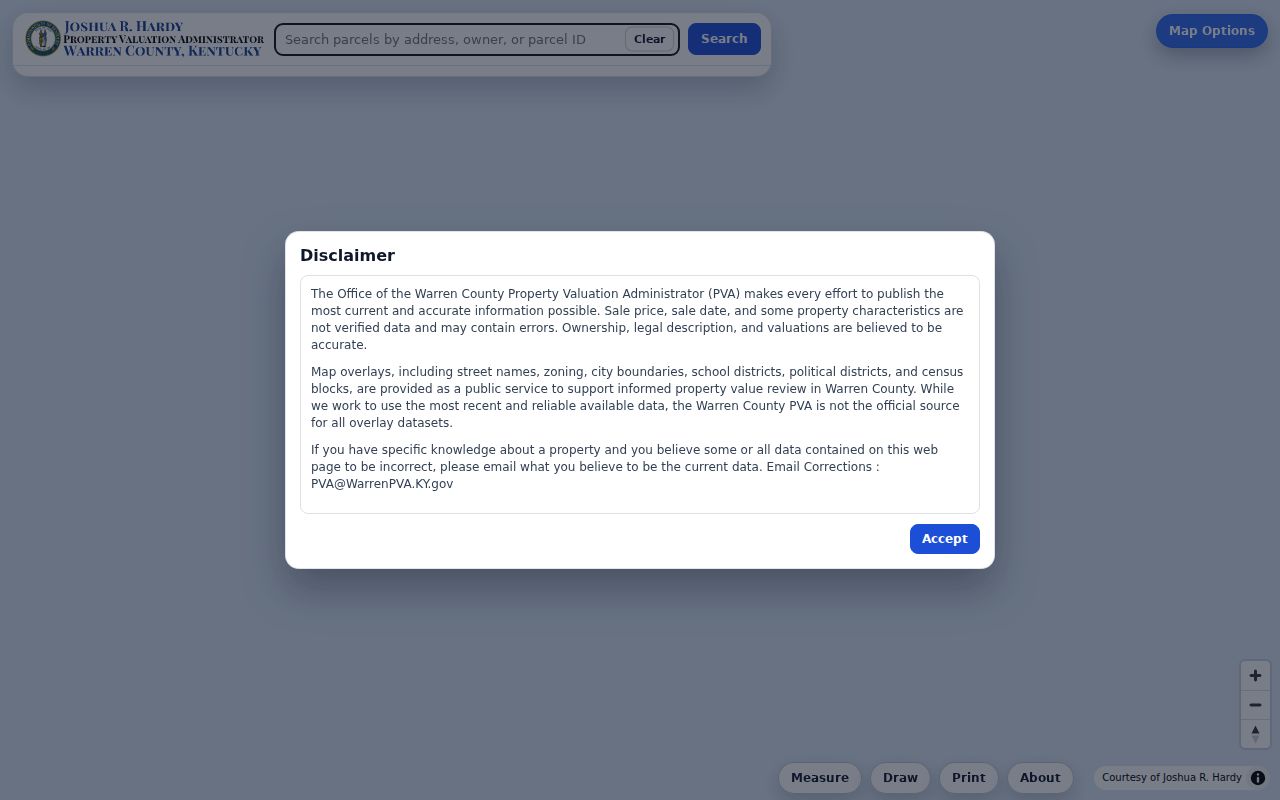
The screen pairs the search box with map controls. That makes the parcel ID the practical bridge between card and mapped tract.
Why Warren County Land Records Need Names
The Clerk's eCCLIX system indexes by party name and document type. It cannot search a street address. Anyone starting from an address must get the owner from the PVA first. Then search that name as grantor or grantee. A grantor transfers an interest. A grantee receives it. Run both sides and test middle initials, trusts, business names, and alternate spellings.
Warren County residents get a Warren-only, personal, noncommercial option with five free searches per day. Commercial access, extra counties, and document images carry separate account terms. eCCLIX pages show conflicting official price examples. So confirm current charges before buying.
The Clerk's eCCLIX overview covers the name-based rule and the resident route.
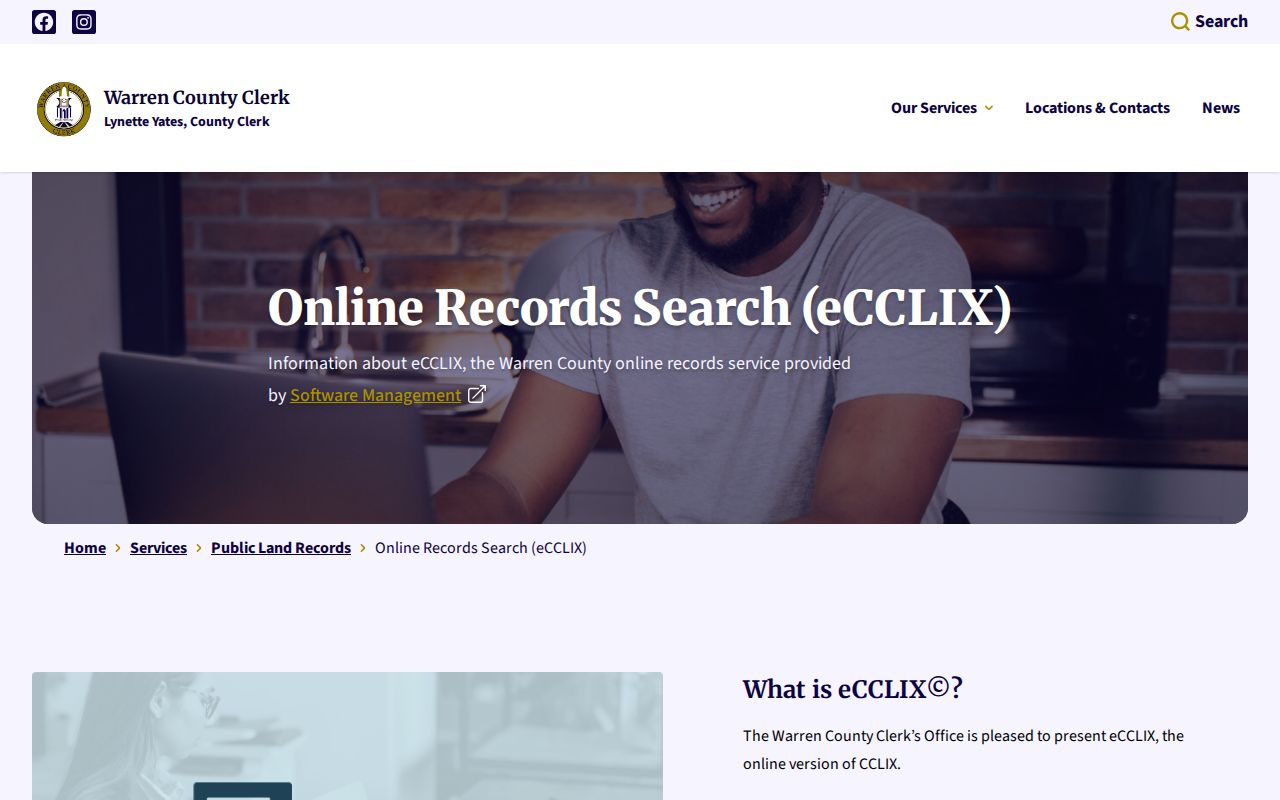
This distinction prevents a familiar dead end. Typing a street into a system built for people, firms, and document types returns nothing useful.
Warren County Property Record Types
A full Warren County property file can stretch across several public systems. The table sorts each source by what it actually proves. An assessment card is strong evidence of the current tax roll. A deed is the recorded transfer instrument. A GIS line is not a surveyed boundary. Keep that distinction in mind.
| Record | What It Documents | Keeper | Access Route |
|---|---|---|---|
| Deed or mortgage | Recorded transfer or lien instrument | County Clerk | eCCLIX, deed-room terminal, copy request |
| Assessment card | Owner roll, values, sales, land and improvements | PVA | Free portal, office, phone |
| Current tax bill | Bill, balance, payment and projected amount | Sheriff | PVDNet, phone, office |
| Parcel and planning map | Tax geometry, zoning, land use, address context | PVA and CCPC | Web maps, GIS services, office |
| Permit file | Applications, inspections and approved work | County or city office | Portal, office, phone, records request |
For deeper mechanics, turn to the Warren County property search. The focused pages in the records lists take deeds, taxes, parcels, owners, neighbors, and value on their own terms.
Warren County Tax Record Handoff
The Sheriff's PVDNet route finds current real-estate tax bills. Search by name, account number, parcel number, or street name. It also accepts an optional projected date for interest and penalty math. A surname or its first three letters starts a query. Online payment updates after 7 p.m. on business days. So keep the receipt and mind the timing before assuming a balance moved.
Unpaid bills shift from the Sheriff to the Clerk after April 15. They become a certificate-of-delinquency matter. The Clerk, County Attorney, and any court case may each hold a piece of the later history. A bill name can also reflect the January 1 assessment context. So treat it as a tax record, not a deed.
Note: Current bills start with the Sheriff; delinquent bills after transfer need a Clerk and County Attorney check.
Warren County Property Records on Planning Layers
The PVA map layers parcel boundaries with roads and street names. It also adds terrain, zoning, school districts, political lines, and census tracts. Aerial imagery runs from 2011 through 2026. Sales overlays split into two windows. One covers the last 18 months, and a second band reaches back 18 to 48 months. Measure, draw, and print tools let a researcher keep a trail while comparing parcels. Remember, though, that the parcel lines exist for tax work. A recorded plat or licensed survey settles any legal boundary question. For planning context, the City-County Planning Commission web maps go further than the PVA. They add land use, historic districts, and focal-point plans. Development conditions, permits, signs, and applications appear too. Site plans and current, future, or retired addresses round out the set. Those layers tell the story behind a parcel.
- Parcel
- A tract used by the tax and mapping systems.
- Plat
- A recorded drawing that lays out lots, roads, and related features.
- Assessed value
- The PVA value used in the property-tax system.
- Situs
- The physical location address, which may differ from an owner's mailing address.
Permit Lines Across Warren County
Permit custody in Warren County follows the municipal boundary. Warren County Building Services issues permits everywhere except inside Bowling Green and Oakland. Bowling Green runs its own Building Division through eSuite. Smiths Grove and Oakland share the joint zoning framework through CCPC, though neither city publishes a permit search with a documented field list. Never route a parcel by its mailing city. Confirm the city boundary, tax district, PVA card, and planning map first. The Warren County SmartGov portal handles permits, inspection requests and results, reports, documents, and property-maintenance reports. Applications inside Bowling Green or annexed areas get cancelled. The county asks for 48 business hours to review a complete submission.
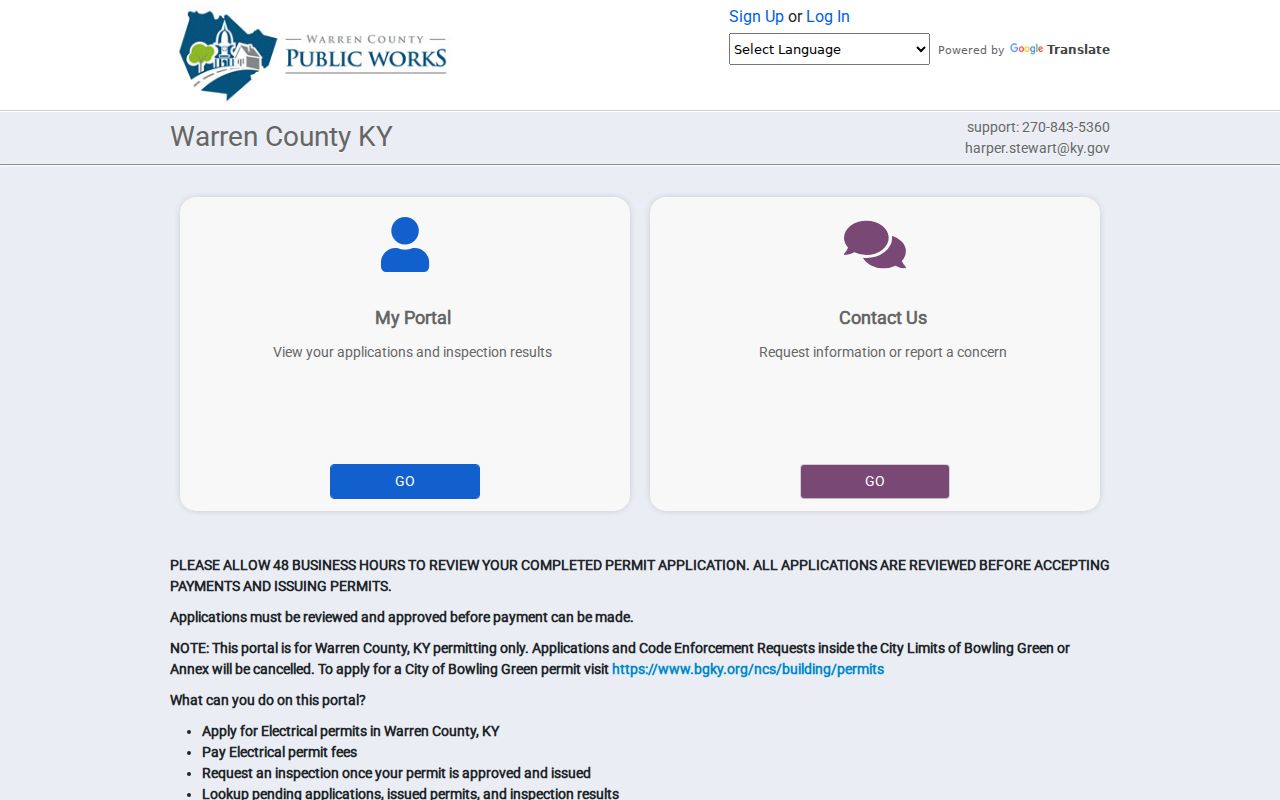
The official county portal page displays the entry point for permit searches and applications. Check the city limits first, since the portal does not serve every Warren County address.
Warren County Deed Alert Option
DOCALERT is a free notice service. It covers deeds and mortgages recorded in a registered person or business name. The form confirms the county, each name field, and any suffix. It also covers business or trust status and an email address. An alert can flag a filing worth a look. It cannot block an instrument, insure title, or judge a filing's validity. The DOCALERT registration form shows the exact confirmation fields Warren County notices rely on.
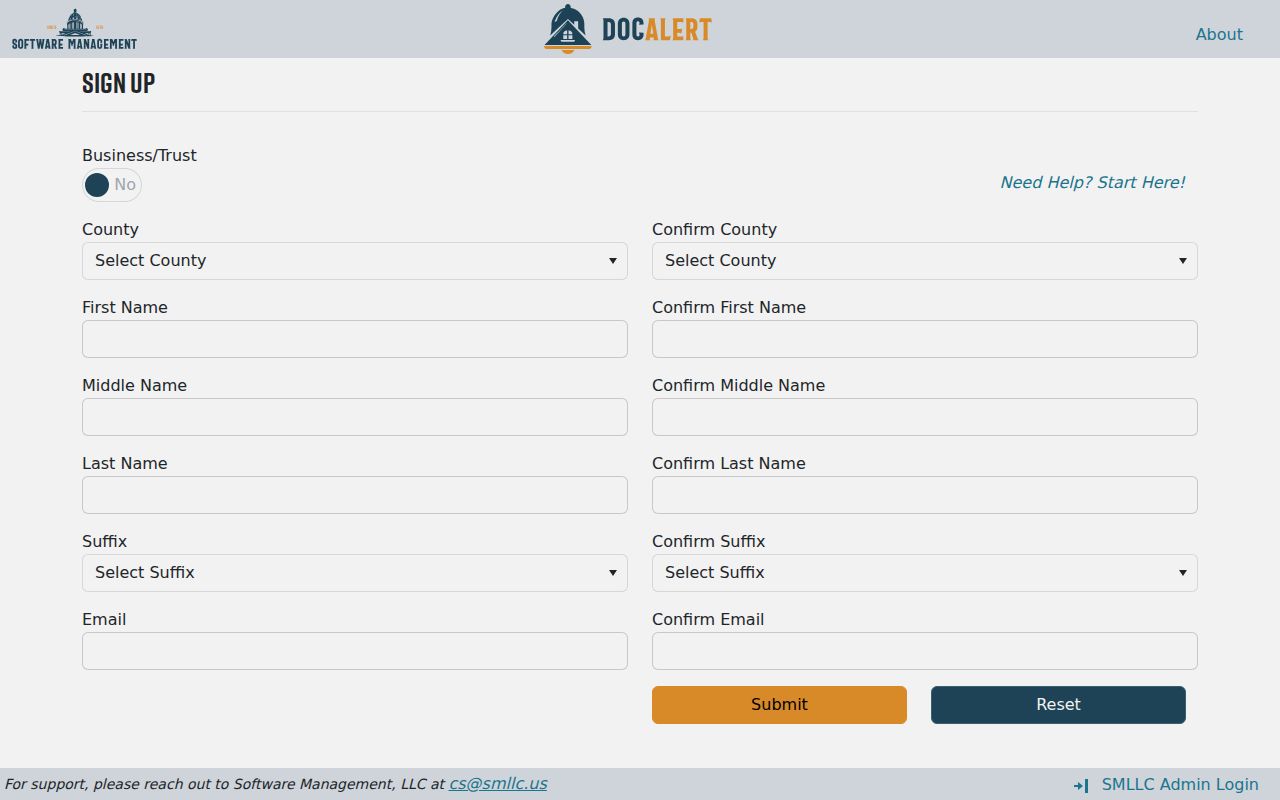
County, name, and email entries repeat on the form for a reason. Exact spellings determine whether an alert catches a filing for a person, trust, or firm.
Historic Warren County Land Records
Warren County property records reach far beyond the live portals. The Kentucky Department for Libraries and Archives inventories deeds from 1797 through 2012. It also inventories wills from 1797 through 2011, surveys from 1799 through 1939, and early tax assessment books. For post-1890 deeds, book-and-page references let you walk the chain backward. Earlier tax books and survey references can bridge gaps the deed record leaves open. The Warren Public Library holds early deed abstracts. Its shelves add will books, directories, newspapers, cemetery books, and family histories. WKU Special Collections adds surveyor and commissioner books. The collection also spans city directories, equity and land-title disputes, and local court material. KDLA takes remote requests and estimates four to six weeks. Its fee runs $20 in-state or $25 out-of-state. Page and postage charges apply past the stated threshold.
Warren County Property Record Timing
Kentucky law sets January 1 as the assessment date, and real property is valued at 100 percent of fair-cash value. The Warren County PVA examines each parcel at least once every four years. Because of that staggered cycle, a tax record, a deed date, and a current parcel card may each reflect a different point in time. Keep those dates straight when you read a file. A PVA report from December 13, 2024 described an inherited backlog of about six months of deed transfers as cleared. It also said deeds were moving into the PVA system within one day of appearing on the Clerk's site. That was a performance snapshot, not a guarantee. New closings can still lag the roll.
Each value field carries its own timing too. Fair-cash value is the PVA's estimate under Kentucky assessment rules. Taxable value can drop once a lawful exemption applies. A sale price speaks to one transaction only. Recent and older sales layers help locate comparable transfers, but the PVA cautions that sale data can be incomplete or unverified. Anyone reviewing Warren County property records should weigh similar use, acreage, structures, and location first. For a true market opinion, order an appraisal. Appeals start with a PVA conference. Bring evidence such as recent arm's-length sales, an appraisal, photographs, repair estimates, leases, or income and expense data as applicable.
Warren Liens and Court Clues
Mortgages, releases, assignments, tax certificates, and certain liens sit in the Clerk's recording system. Foreclosures, quiet-title disputes, probate matters, and land cases usually have a court file instead. The Warren Justice Center clerk is the local starting point for copies. CourtNet also covers cases. Its case search and details run on a subscriber model.
Cross-check names and parcel facts in both places. A docket lists litigation events. It is not a final title opinion. A recorded mortgage, though, may carry a later release or assignment, so trace the full instrument chain before trusting a single index row.
Probate adds another wrinkle. A death says nothing about how land passed. Begin with the PVA parcel and read the latest deed, then hunt for a will, estate order, affidavit, or later deed tied to the owner. Warren County deeds and wills appear in KDLA's inventory. The local court clerk and WKU collections may also hold estate or land-title material. Separate similar names with dates, spouses, parcel descriptions, book and page references, and the court case number. That method ties the person to the tract without mistaking a family name or an obituary for proof of ownership.
Limits of Warren Property Records
Warren County property records show the assessed owner, recorded transfers, values, tax activity, parcel context, and public planning files. They have limits. No index captures every unrecorded claim, and the records cannot guarantee clear title, set a legal boundary, or state what a property would sell for. Commercial data tools may merge old or unrelated data. Official custodians offer the stronger path, since the record, its date, and its keeper stay visible.
Kentucky's Safe at Home program can substitute a protected mailing address in many public records. Real-estate holdings are exempt. Real property addresses stay public. The Secretary of State says so. Use the data for lawful research, due diligence, boundary work, tax review, estate matters, and civic transparency.
Check the source. A record search is not a title search, appraisal, or survey. Confirm critical facts with the office that holds the record, and never use owner data to harass or harm anyone.