
Trace Warren County Former Owners Backward
Trace Warren County former owners from the newest confirmed deed backward. Move from each grantee to the grantor who conveyed the same legal description. Keep a working transfer log rather than copying from the tax roll. Record the deed type and book/page in each row. That way the next link in the chain can always be checked. Match each one against the recorder's own documents.
| Transfer Date | Grantor to Grantee | Deed Type | Book/Page |
|---|---|---|---|
| Newest deed | Current grantor to present grantee | As recorded | Save exact reference |
| Prior deed | Earlier grantor to newest deed's grantor | Warranty or other stated type | Follow prior reference |
| Earlier book | Repeat for the same tract | Do not assume | Match legal description |
| Archive bridge | Tax or survey name to deed candidate | Supporting source | Cite volume and year |
The County Clerk's eCCLIX guidance shows the index works by party and document type, not street address. Start with the PVA parcel when only an address is known. The Clerk's online records page lays out the Warren eCCLIX access route and its indexing limit.
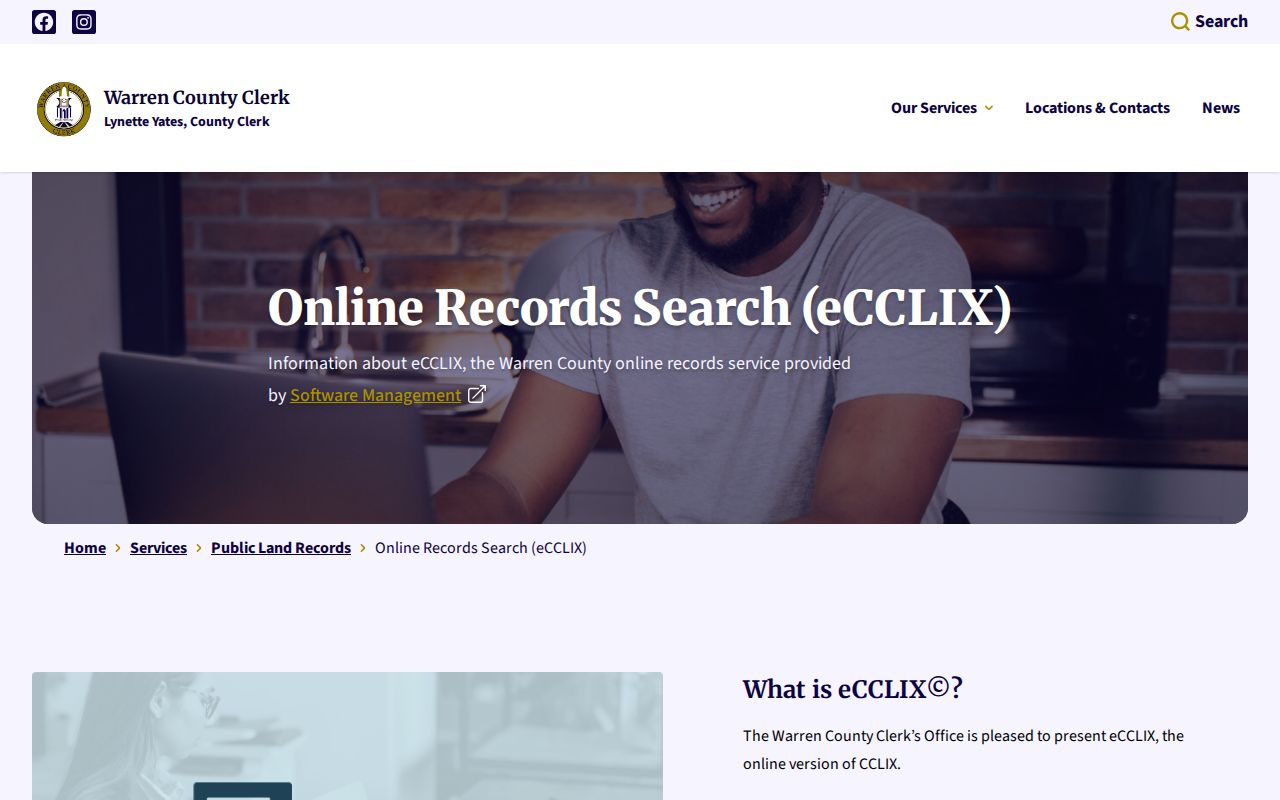
The portal is only a name-search starting point. The chain still stands or falls on each recorded deed and the prior reference it carries.
Start With a Warren County Prior Owner Reference
A current deed often recites a prior deed book and page. That citation is the cleanest backward link. It points to the very instrument by which the grantor once acquired the tract. Compare legal descriptions, exceptions, easements, and acreage. Do this before accepting the match as part of your Warren County property search.
Without a clear prior reference, search the grantor as a grantee instead. Narrow the deed records by date and document type. Watch for alternate spellings, initials, fiduciary terms, and entity names as well.
Reconstruct Warren County Former Owners by Deed
A chain of title is the ordered sequence of transfers for one piece of land. Build it backward. Verify each link before moving to the next deed.
- Find the current owner's deed with that owner as grantee.
- Read the grantor and the instrument's prior reference.
- Search that grantor as a grantee in an earlier period.
- Repeat until the online index ends, then move to deed books and microfilm.
- Grantor
- The party conveying an interest.
- Grantee
- The party receiving an interest.
- Reverse index
- An index used to locate a party on the receiving side.
- Quitclaim deed
- A deed conveying whatever interest the grantor has, without a warranty of title.
Find Warren County Previous Owners in Deed Books
The KDLA land-record inventory lists Warren County deeds on microfilm from 1797 through 2012. Wills run from 1797 through 2011, and surveys from 1799 through 1939. Those ranges give former-owner research real depth in time.
KDLA reports a four-to-six-week estimate for records requests. The Clerk's deed room offers alternatives. Its archive request route does too. Microfilm is another option when an online deed image is missing.
Bridge Warren County Prior Owners With Tax Books
KDLA also inventories Warren tax assessment books covering 1797 through 1892. It holds original books for 1944 through 1950. A tax book can place a name beside a tract or year. That helps when the deed link is hard to read. It never replaces the recorded conveyance itself.
Treat the tax entry as a lead. Form a deed candidate. Then confirm the name, neighbors, acreage, district, and legal description in the land books. Do that before logging that owner of record in the chain.
Connect Warren Plats and Surveys
Recorded plats can preserve subdivision name, lot, road, easement, and book/page clues in one place. Survey books help bridge rural tracts. A planning exhibit may repeat useful references. But it proves neither a boundary nor a former owner on its own.
The Wheeler Estate example names Lot 3. It also cites Plat Book 4 Page 197 and deed Book 1283 Page 212. It warns the exhibit is not a legal description. Follow those references to the Clerk's recorded documents for anything conclusive.
Resolve Warren County Former Owner Probate Gaps
A clean sale-to-sale chain often breaks at death. Wills, probate orders, fiduciary deeds, and land-title disputes explain how an estate conveyed an interest. Warren Circuit or District Court records can supply case context around the transfer. WKU Special Collections can supply context too.
Keep a will beneficiary separate from a deed grantee. Connect the two only when the land instrument ties that person to the parcel. A court order can also make the link.
Research Warren Street Changes
Old deeds may carry no modern street number. CCPC Address Explorer shows current, future, and retired addresses. Plats and deeds preserve lot, road, and legal-description clues, while Bowling Green annexations can shift city context without changing the county parcel number.
When the old address fails, search by subdivision, lot, map number, owner, nearby road, and deed reference. Never rewrite a legal description from a GIS polygon.
Use Warren Library Collections
The Warren Public Library genealogy collection holds early deed abstracts, will books, directories, and newspapers. WKU Special Collections adds local directories, surveyor material, and land-title dispute sources. Together they can explain an occupant or a business. They can also explain a street name in the deed records.
A directory occupant is not automatically a former owner. Take the clue back to the deed chain and document the actual transfer.
Follow Warren Legal Descriptions
Street addresses are weak links in an old ownership chain. A Warren County deed may describe land by subdivision and lot, plat book and page, metes and bounds, or acreage. It may also cite a reference to an earlier instrument. Copy the description exactly. Include exceptions, reservations, easements, and "less and except" clauses. Those details separate a parent tract from a later split.
Compare each deed's calls with the next deed in the chain. A matching surname is not enough. Road names change, and parcels get divided. Annexation can alter municipal context. The land description may still run from an older county deed. Where a plat exists, note the subdivision name, lot or block, and the recording reference. Also note any covenant or easement references for the parcel.
Audit Warren County Prior Owner Chain Gaps
A gap between two deeds is a signal, not an invitation to guess. Mark the break and keep looking. Variant spellings, spouses, fiduciaries, trusts, and entity predecessors often hide the missing deed. Quitclaims, correction deeds, probate orders, court judgments, and plats can bridge what the main index misses. Tax books and city directories help narrow the likely year. Only the proper land record or court record, though, should actually close the link.
The FamilySearch catalog lists Warren deed books and general indexes, though access restrictions may apply. Offline channels still work well. The Clerk counter, the KDLA request service, the Warren Public Library, and the WKU collections each offer a distinct route. Each one reaches the same volumes. For every search, record the collection, volume, page, search date, and any item that could not be reached. That log builds an honest Warren County property records history. It stays honest even when one image or index entry stays out of reach online.
Measure Warren County Former Owner Time Depth
Warren County's archive inventory opens its deed coverage in 1797. Treat that year as the documented boundary of the collection. It says nothing about whether every chain is complete. No official Warren County source records a courthouse fire. So describe gaps from the actual holdings rather than local folklore.
Record limit. Online eCCLIX is only one access layer. Older Warren former owners may require deed books, microfilm, tax books, surveys, wills, and archive requests.
Former-owner research serves real purposes: house history, title diligence, estate work, and civic study. It must never be used to track, harass, or harm a living person.
Build a small ledger for every former owner of record. Enter the exact name as indexed. Note the role as grantor or grantee. Record the instrument type, the deed date, and the recording date. Add the book/page or instrument number, plus the piece of the legal description that ties the transfer to the parcel. This discipline keeps a same-name stranger out of the chain. It also shows when a trust, estate, spouse, or entity appears in only one instrument.
Keep historic context in its own column. Oakland's official history notes railroad development, a commercial-district fire, and surviving civic and commercial buildings. None of that identifies the owner of a specific parcel. A city history or newspaper can suggest a date, a business, or a street spelling. Before any of it enters the ownership sequence, pair it with a deed, plat, tax book, directory, or court record.
Never hide an unresolved interval. Name the last verified grantee. Name the next verified grantor. Then note which index, volume, or archive sits between them. A documented gap beats a seamless but unsupported chain.
Save negative searches as well. The party spelling, date range, document type, index or volume, and access date show exactly what was tested. The Warren County property search then moved on with a record of it.