
Warren County Tax Record Layers
Warren County property tax records do not sit in one file. The PVA keeps the assessment and the owner card. The Sheriff collects the current real-estate bill. After the statutory collection window, an unpaid bill moves to the County Clerk and may become a certificate of delinquency. Read each field in the system that owns it.
| Field | What It Shows | Where |
|---|---|---|
| Owner and parcel ID | Assessment-roll identity and map key | Warren PVA |
| Fair-cash and assessed value | January 1 valuation used in assessment | Warren PVA |
| Taxable value | Value after applicable treatment | Warren PVA parcel report |
| Current bill and status | Amount payable for the current collection | Sheriff PVDNet |
| Delinquent certificate | Post-April 15 unpaid bill record | County Clerk and County Attorney |
Kentucky assesses real property at 100 percent of fair-cash value as of January 1. That is an assessment rule, not a promise that the parcel would sell for the same sum. The PVA report also carries sale information, but its disclaimer says some sale data and property characteristics may be unverified. The bill is a collection record. A deed is the transfer record.
Search Warren County Property Tax Bills
The Sheriff's tax instructions lay out four routes to a bill inside PVDNet. A projected date figures the expected amount for a later payment. Name searching accepts a last name. It also takes just the first three letters. Parcel and account numbers cut same-name errors.
| Search field | Best use | Check before relying |
|---|---|---|
| Name | Find a bill when the roll name is known | Match parcel and situs |
| Account number | Return to a known tax account | Confirm the tax year |
| Parcel number | Bridge PVA and Sheriff records | Keep punctuation and leading zeroes |
| Street name | Find a bill when no account is at hand | Distinguish nearby parcels |
| Projected date | Estimate penalty and interest by date | Verify the final portal amount |
The Sheriff answers for current bills only. Prior-year delinquent questions belong to the County Clerk, a split worth remembering when PVDNet shows a different balance than expected.
Read a Warren County Tax Bill
Begin with the exact parcel rather than a broad name match. Names repeat across Warren County. A careful read of a tax bill pairs the tax year, account or bill key, property description, name on that year's roll, amount, payment state, and projected total. The January 1 assessment date explains a stale name. A mid-year seller can still appear.
- Find the parcel on the PVA site and save its parcel ID, situs, owner field, and assessed value.
- Open the Sheriff PVDNet portal and search the parcel number, account, name, or street.
- Choose the right tax year, inspect the payment state, and use a projected date when paying after a rate change.
- If the bill is from a prior year or has passed the Sheriff period, check the Clerk's delinquent list and confirm certificate status.
- Fair-cash value
- The PVA's estimate of full value under Kentucky assessment rules.
- Taxable value
- The value to which tax treatment applies after relevant exemptions.
- Homestead exemption
- A qualifying Kentucky reduction handled through the PVA application process.
- Certificate of delinquency
- The post-collection unpaid tax claim handled through the Clerk process.
Warren PVDNet Search View
The official Warren County PVDNet portal is the live current-bill search destination.
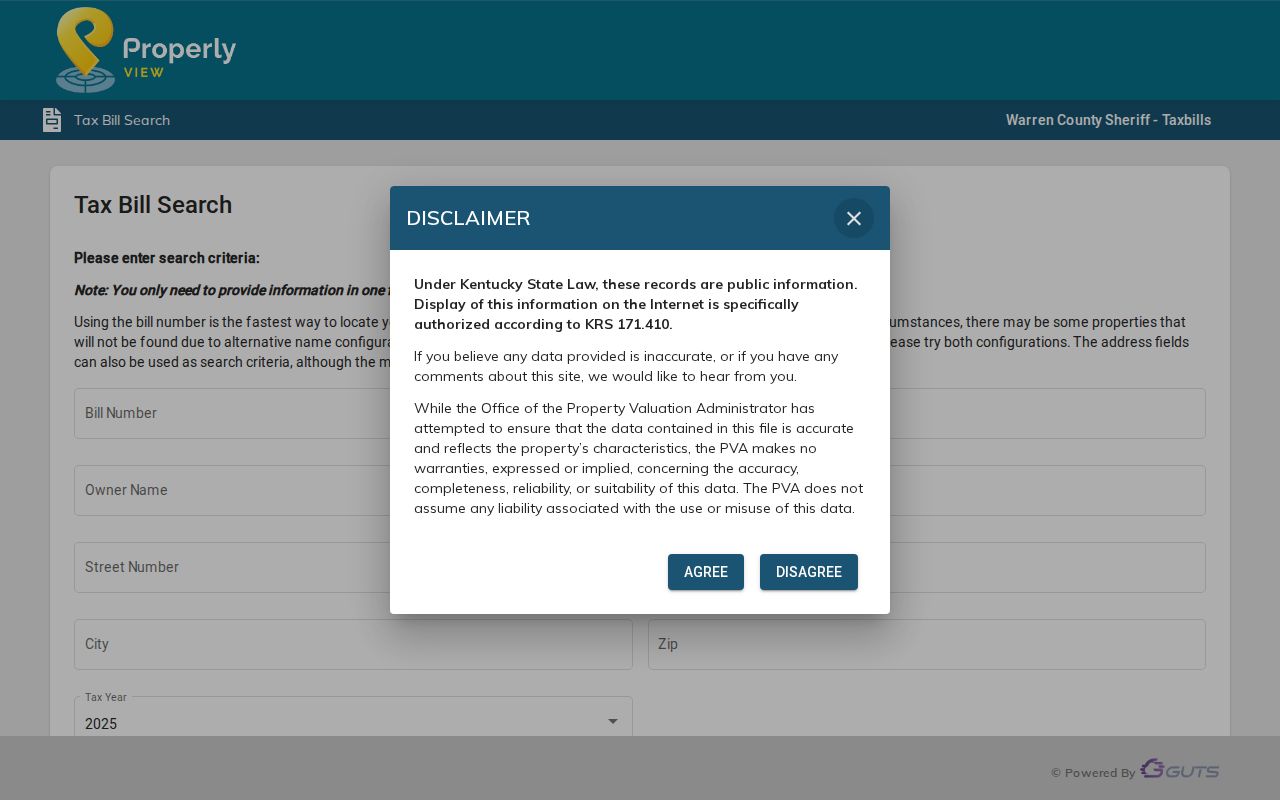
Pair the portal view with the Sheriff's instructions. Save the tax year and parcel key with each receipt, since search results and projected sums can shift after posting.
Warren County Property Tax Calendar
Warren County property tax runs on a schedule. Early payers win a 2 percent discount. That window spans October 1 through November 1. Face amount applies from November 2 through December 31, after which penalties begin. January 1 through January 31 carries a 5 percent penalty. February 1 through April 15 adds a 21 percent penalty. Current bills stay payable at the Sheriff. The Sheriff's current tax inquiry page points taxpayers to the collection service.
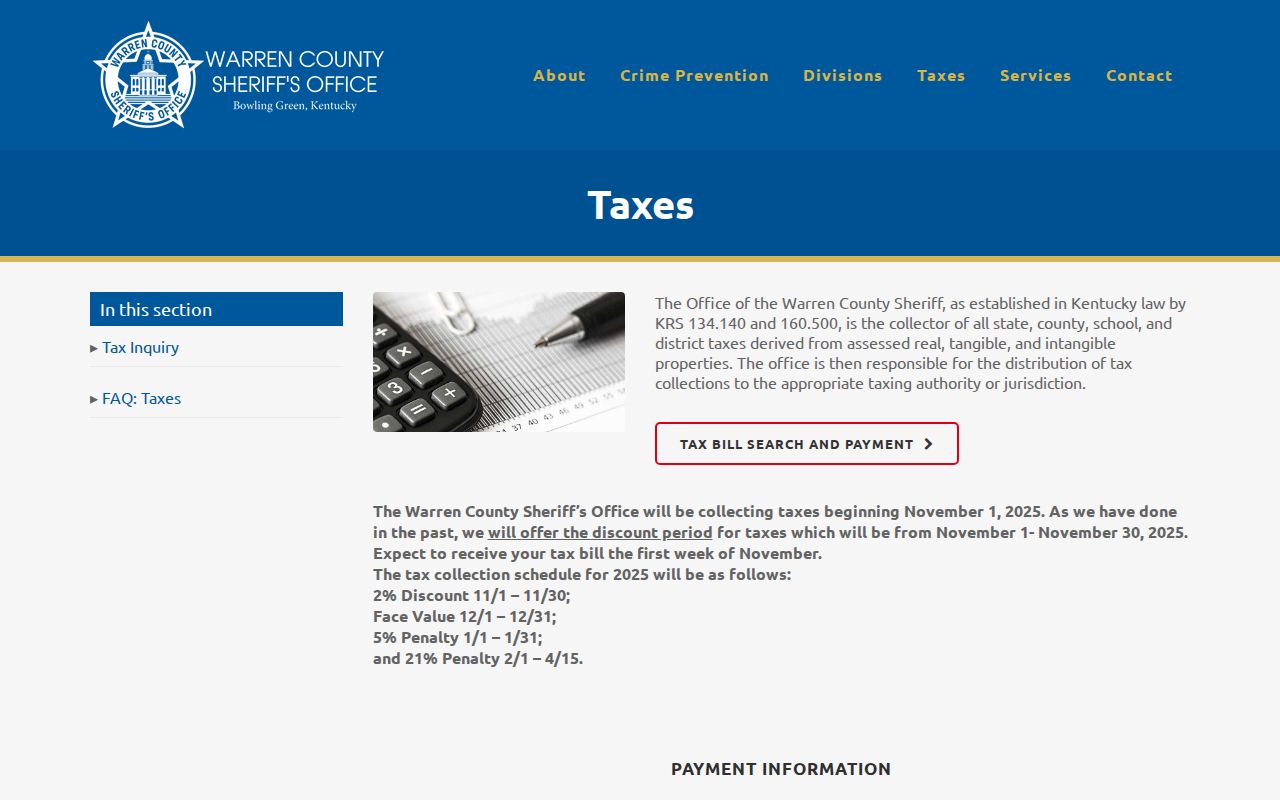
The official entry page lays out the payment route. Use the live bill result and its tax year. Do not use any image for a current balance.
A card charge of $60 or less costs $1.50. Above $60, cards cost 2.49 percent, and ACH or e-check runs $1.50. Online payments update after 7 p.m. on business days, so same-day totals can lag. No partial payments are accepted on current-year bills. A canceled check or a printed online receipt can document payment.
Note: Recheck the official Warren County property tax schedule for the tax year at issue before calculating any payment.
Warren Assessments Start January 1
The PVA assesses real property each January 1. State law requires each parcel to be physically examined at least once every four years, with permits and property inspection feeding that field work. That cycle explains the lag. Current Warren County property tax records can trail a new sale or conditions appearing later in the year.
The PVA parcel report splits its data cleanly. Owner and sales details sit apart from land, improvements, total fair-cash value, assessed value, and taxable-value sections. That structure helps during a review. A sale price is one lead, not an automatic assessment, so weigh comparable arm's-length sales and like features before disputing the fair-cash figure. The Warren County home value page unpacks the differences among these values.
Warren County Property Tax Exemptions
The Warren PVA publishes separate material on age and disability exemptions and on agricultural or horticultural treatment. Eligibility and proof belong with the PVA. The Sheriff's payment portal plays no part. Applications and downloadable forms are available through the PVA site, and a property fitting a category does not mean an exemption applies.
Keep three numbers apart in any review: fair-cash value, assessed value, and taxable value. An exemption changes the amount subject to tax. It never rewrites the deed or sale history. Agricultural treatment carries its own acreage and application rules. Amounts and form windows shift, so check the current official page and the parcel report.
Note: An exemption changes tax treatment; it does not change the owner, legal description, or recorded Warren County deed.
Appeal a Warren County Assessment
Start with a conference at the Warren PVA during the open-inspection period. Bring the notice of change and a clear statement of the issue. Recent arm's-length comparable sales carry the most weight. Some parcels call for more. An appraisal, photographs, repair estimates, or leases and income and expense records can all help. Another parcel's assessment is weaker proof of fair-cash value.
An unresolved conference is not the end. Get the conference summary. Then file through the County Clerk for the local Board of Assessment Appeals. The deadline is the first working day after the inspection period closes. A dispute can then move on to the Kentucky Board of Tax Appeals. For 2026, the PVA page shows the conference and open-inspection period concluded May 18. So confirm the live calendar for whatever year applies.
Evidence has to line up with the assessment date. Every comparable needs its sale date, location, property class, acreage, and improvement facts marked. Add a sentence on why it bears on the subject's January 1 fair-cash value. Photographs and repair estimates should show the condition that existed on that date. Keep every submission and the conference summary. The next review body needs a clear record of what the PVA already heard.
Appeal window. Meet with the Warren PVA first, then file for the local Board by the first working day after inspection closes.
Warren County Property Tax Certificates
Unpaid bills turn over after April 15, and the Sheriff's current-year search stops being the whole answer. The Clerk publishes delinquent-tax information, while the County Attorney explains that a certificate of delinquency operates as a recorded lien under KRS 134.122. The statutory interest rate runs 12 percent under KRS 134.125, and after 90 days a third party may purchase a certificate under KRS 134.452. The County Attorney delinquent-tax explanation traces the route that begins once a bill goes unpaid.
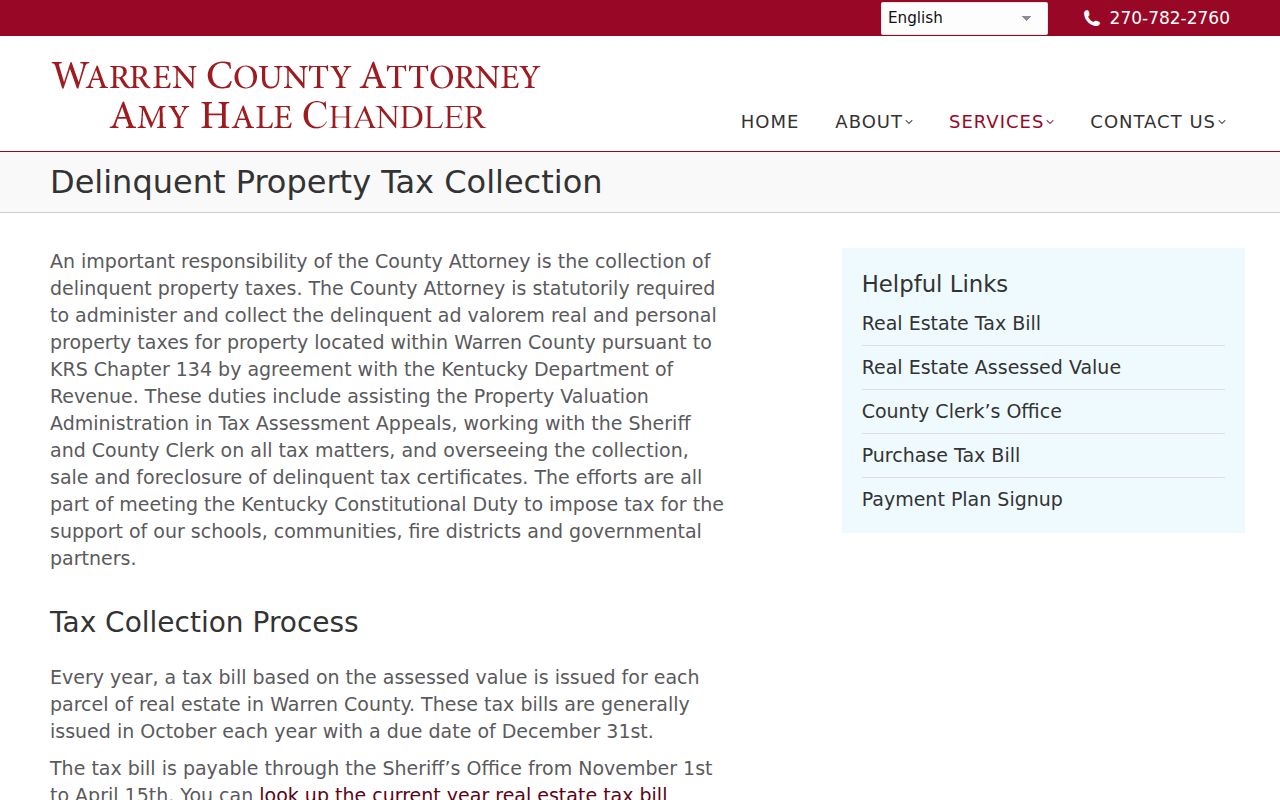
Confirm the certificate's status first: paid, sold, released, or still open to costs. A delinquent list is not proof of current title. It says nothing about a person's character.
Warren County's 2026 Tax Sale
The County Clerk's current notice sets the annual sale for August 26, 2026, at 9:00 a.m. Central. Registration is due August 17 at 4:30 p.m. at the courthouse office. Third-party purchasers register with both Kentucky and Warren County. They also use Department of Revenue form 62A374. Those dates and forms change every year.
The prior process document lists what a bidder faces: bill number, taxpayer name, property address or map code, amount due, priority items, and cash or certified-funds rules. Treat it as a sample procedure. It names no bill that is still due. Before relying on tax-sale status, check the Sheriff's current balance, the Clerk certificate, the sale notice, and any later payment or release.
A certificate purchase is not an ordinary deed transfer. Court action, notice, payment, redemption, and later recording can all affect the trail. Write down the certificate year, bill number, parcel key, purchaser status, and the date checked. Then inspect the Clerk index for any release or later instrument. The tax list alone cannot establish who owns the land today.